
Why I Don’t Chase Perfect Takes
Finishing a song isn’t about correcting every imperfection. It’s about knowing when the story is there, and leaving the listener enough room to find their own meaning in it.
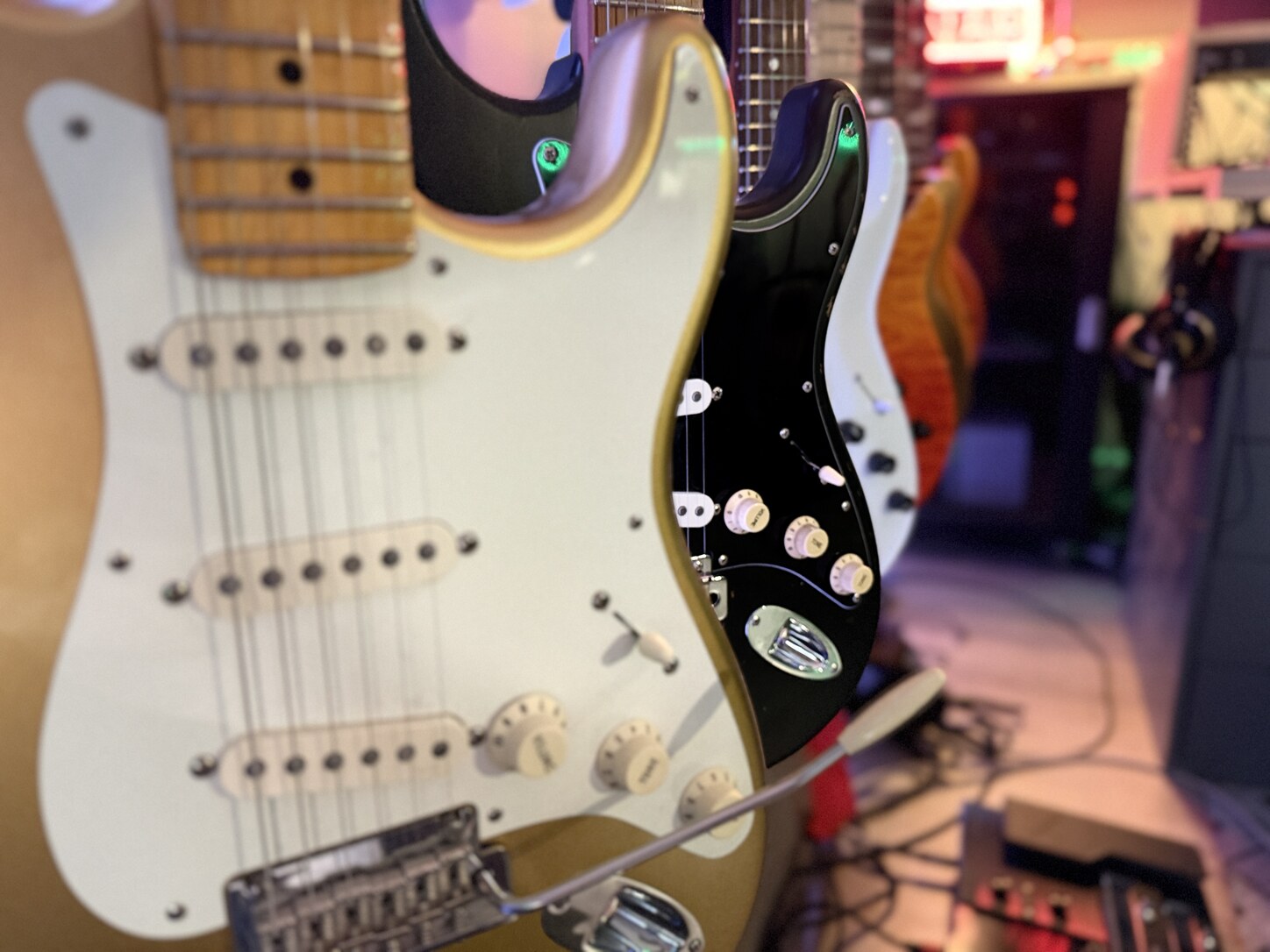
Guitars in Jamie Penner’s studio.
A lot of my songs start before I ever sit down to record them. They show up while I’m out for a walk, warming up in the studio, or just playing around before I’m supposed to be working on something else. A lick, a bass line, a harmony, a rhythm, or sometimes just a feeling turns up out of nowhere. The trouble is I lose a lot of good songs on those walks.
If an idea makes it into the studio, I usually start by giving it some kind of foundation. A riff, a bass line, a hook, a harmony. From there I start asking what the song is actually about. Is there a feeling behind it? A theme? A moment? Is it meant to tell a story, even without conventional lyrics?
Almost all of my music starts with some kind of concept. I’ve always liked the storytelling side of it, and instrumentals give you a lot of room to work with. You can set a mood or suggest an idea without explaining every part of it, and the listener gets to meet the song halfway. That’s one reason I don’t chase perfect takes.
Denim Blues started with the bass
With Denim Blues, from my second album Odyssey, the bass line came first. Once that was there I started putting the sections together with keyboards and drums, and that’s where the feeling took shape. The structure wasn’t just a set of parts lined up in order. It was the beginning of the atmosphere the song needed.
After that I recorded the basic guitar tracks. Those built the song out, but the last piece was the talkbox. It’s a pedal that drives a small speaker inside the unit, and the sound travels up a plastic tube into my mouth, where I shape it into words while a microphone picks it up.
The talkbox became the voice of Denim Blues, though not a vocal in the usual sense. One reviewer didn’t like my vocal treatment on the song. There are no vocals on it. That’s a guitar.
A voice without giving everything away
The talkbox has a few phrases in there that are meant to be heard. “You’ve got the denim blues.” “You’ll never hide from the denim blues.” “They’ll always find you, the denim blues.” There are other moments where people hear words that aren’t necessarily there, and that’s part of the fun of it.
The title was chosen to leave the meaning open. What are the denim blues? Someone feeling blue? Blues music? The colour of someone’s eyes? Blue jeans? It can be any of those, or none of them.
That meant walking some of the talkbox parts back. At one point there were clearer phrases that said too much and gave the idea of the song away. They made the story narrower. They told the listener what to think instead of letting the title and the music do their work.
The final version still has those recognizable lines, but the talkbox isn’t there to deliver lyrics. It’s another instrument in the arrangement. The guitars, keys, bass, drums and talkbox are having a conversation, answering each other with musical phrases. That balance mattered more to me than making every idea obvious.
Catching the moment
I almost never play a song exactly the same way twice, and that’s especially true when I’m recording. I’m trying to catch the raw playing and the feeling of that particular moment. If I keep changing it, reworking it, trying to make it more precise, I can lose the thing that made the take worth keeping in the first place.
There’s always something else that could be polished. A note could be changed, a phrase cleaned up, a part tightened or expanded. The possibilities don’t run out on their own. The musician has to decide when to stop.
That doesn’t mean settling for something unfinished. A recording still has to work. The arrangement has to support the concept and the performances need to feel right. But there’s a difference between finishing a song and continuing to work on it because you can.
With Denim Blues, it came down to what the song was supposed to hold back. Too many clearly spoken talkbox phrases and it got explanatory. It took away the mystery. Once I heard that, the answer wasn’t to add more. It was to take enough out that the song could breathe again.
Knowing when it’s finished
A song is finished when it still sounds like what I meant it to be. That can be hard to judge, because the technical side of recording always offers another option. There’s always another take, another edit, another layer, another small improvement waiting to be made.
But a song isn’t only a collection of well-recorded parts. It’s a feeling, a concept, and a particular performance caught at a particular time. The best take isn’t always the cleanest one. Sometimes it’s the one with the right amount of tension and character in it. Sometimes it’s the take that leaves a question unanswered.
That’s what Denim Blues needed, and once the instruments were saying what they needed to say to each other, it was time to leave it alone.
Continue reading

One Song, Several Royalties: What Canadian Artists Need to Know
Releasing music and collecting everything it earns are two different jobs. Here is how the main royalty streams fit together for an independent Canadian artist.
Read the story →